

The immune system resists outside influences to the body. How should that factor into designing gene therapies? When it comes to adaptive immune responses, you have to contend with the paired problems of what you deliver and how you deliver it being recognised by the immune system. Here I'm talking about T cell responses which have the potential to both cause severe reactions, especially with high doses, and result in loss of expression if transduced cells are selectively cleared. Currently immunosuppression is the mitigation favoured in the clinic but better approaches are possible.
We've already talked about engineering against neutralising antibodies (NAbs) in a previous blog, which block delivery to the cell. This post is focused on the issues once you're inside. This is an important consideration when designing a transgene, but is also an important aspect in the delivery method. With viruses like AAV you have capsid proteins which internalise and can end up presented via MHCs as targets for both CD4+ and CD8+ T cells – resulting in lowered efficacy, safety concerns and blocking re-administration. This is an important but greatly underserved aspect of building a gene therapy delivery modality.
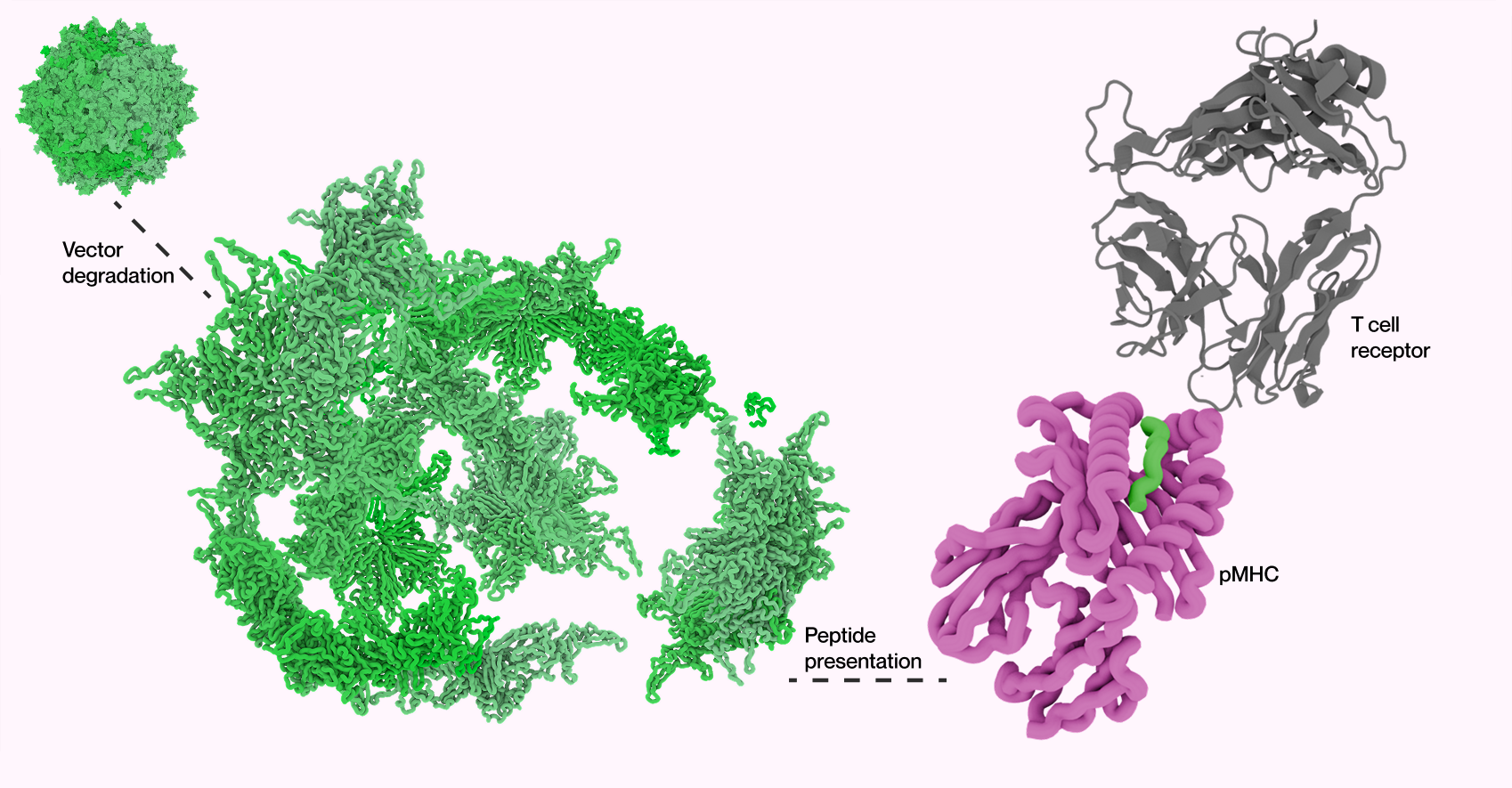
The short answer is yes, but it's not straightforward. Cytotoxic killing of cells containing your delivery vector is obviously bad both from a safety and efficacy perspective. It’s one of the sources of adverse events with liver involvement up to and including death. In liver targeted therapies hepatocytes have been shown to be vulnerable to killing and transgene loss from capsid-specific CD8+ recognition. But the picture is complex, with exceptions and mechanisms that reduce the problem. Tregs in intramuscular injection sites appear to drive low immune responses and lower doses appear to reduce activation but not universally. Like everything touching the immune system this is most likely highly variable between patients.
Patient variability here is mostly via HLA type differences but sex differences and age are also factors in the changing behaviour of T-cell responses between individuals. The general complexity and downstream effects of delivering possible epitopes into cells are a real concern. How to avoid possible negative interactions is one of the most critical aspects of delivery design.
Translatability in immunology is bad and the adaptive immune system is difficult to predict. Animal models used to test gene therapy vectors aren't representative of human biology, and so preclinical development doesn't accurately predict human responses. There are always issues when jumping from in vitro cell models to model animals to humans, but this is especially messy. Allison Keeler gave an excellent talk at ASGCT detailing years of ELISpot data in different animal models. She showed highly differential and unexpected responses in some animals, complicating the question of how best to even study T cell impact on delivery and persistent transgene expression. In cancer therapy development, eliciting T cell responses is often the goal of vaccines and cell therapies – where many in the field (including me) would say we're a long way from having the data to support predicting which epitopes succeed in this, though progress is being made. In the case of viral vectors, the problem space is much more tractable than the human genome, but we still don't have the data to comprehensively call T cell responses and adaptive immune behaviour in a diverse patient set.
Immunosuppression is the common method of control currently, but has many drawbacks and mixed efficacy. Increased infection risks and other complications from long term or high dose steroids are not trivial. There have been a few recent reports of encouraging results from co-delivering synthetic IL-2 to encourage Treg growth in both a recent paper from Sanofi and an ASGCT talk by Mark Ochoa in the Asokan lab. Both of these show a possible way to harness the immune system to tolerate the therapy as a whole. This is a big improvement over otherwise extreme protocols currently in the clinic.
Changing the delivery vector to avoid T cell interactions is the best way to handle this and reduces the design work to optimising only what you're delivering, not how, collapsing the problem space substantially. Previous capsid engineering attempts have argued more efficient trafficking in the cell achieves this, by reducing the availability of capsid proteins for presentation. Similarly with AAV cancer vaccine development, improving efficiency is one way of reducing competition with the payload. These really aren't direct solutions but appear to have some impact on adaptive immune response. Chimaeric vectors targeting specific epitopes have shown engineering can work to remove individual target epitopes, but there are limits to what a completely rational approach can manage. First, much more data is required to interrogate the full immune landscape of delivery vectors. Second, given the size of the combinatorial space across HLA types, classes I and II, and a large suite of epitopes, a sophisticated AI solution is necessary.
In the next phases of Lir's development this is a problem we will be actively solving to improve safety and make redosing a reality. We're already building NAb cloaked variants, but adaptive immune system cloaked viral vectors in AAV and beyond is within our sights. This is a problem waiting to be tackled with new data generation methods and whole capsid modelling. As always I'd love to talk with anyone interested in solving this with us.

© 2025 Copyright: Lir Therapeutics