

Complex problems in biology often have one big question around every experimental corner: are we measuring and optimising for the right thing? This is often a challenge as things move towards the clinic, since big open scientific questions rarely take priority over finding a solution that moves the needle for a therapy quickly. In viral vector engineering for gene therapy, directed evolution and computational strategies have usually aimed to optimise for the outcome of an in vivo study or more recently target an individual receptor. The underlying biology of these viruses is far more complicated than what's being targeted by existing approaches. This limits the potential of what we can do by narrowing focus too early. Gaps in our functional knowledge are one reason things are done this way. Here I'm arguing another path is both necessary and possible.
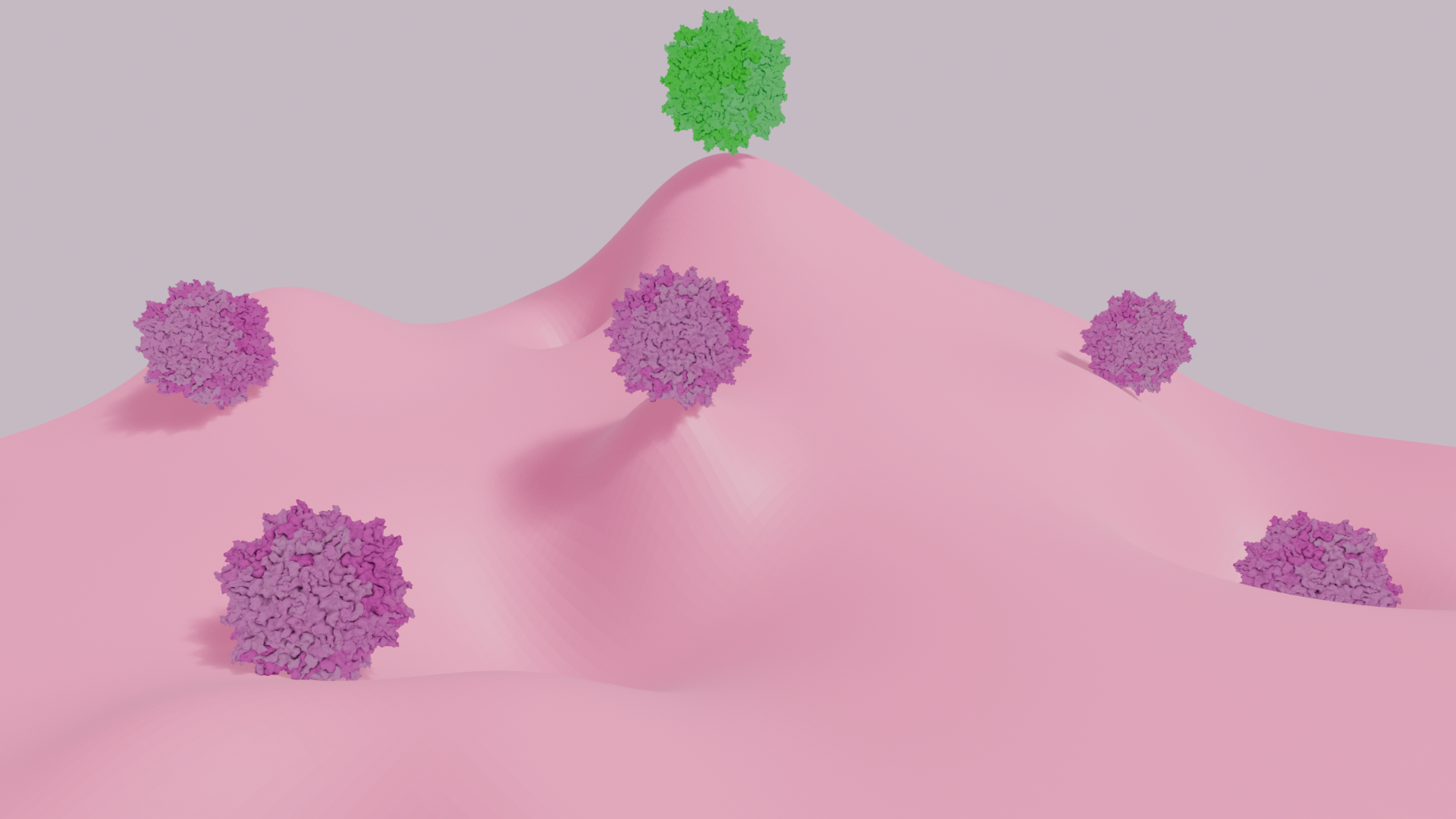
Being in Boston for ASGCT this year inspired a lot of new ideas for how gene therapy vectors can be improved, but in particular a few talks reinvigorated my thinking around how optimising for a single dimension in isolation is missing a lot of the picture. This is crucial to understanding and unlocking the next generation of delivery vectors.
In general the AAV cell entry process is understood as a receptor/co-receptor binding event, followed by endocytosis, endosome escape, trafficking to the nucleus and finally nuclear entry. This is before getting into variations with what goes on in the nucleus. Several points along this path are really only partially understood and many are effectively ignored in engineering attempts, except through indirect means. Much of the more explicit vector engineering in recent years has focused on the start of this process, hunting for specific receptors to bind to in order to serve specific functions, such as blood brain barrier (BBB) crossing or cell/tissue targeting. This approach has several advantages including that in theory it presents a very clear method of action for any change in function. In the BBB case this resulted in the word of the day at ASGCT last year being "transferrin" with at least 9 (by my count) novel variants being shown to target binding it as their main goal. Similarly this year had many approaches targeting a variety of other receptors. A disadvantage is that a single receptor is quite a narrow optimisation target for a multifactorial mechanism. You have no insight into whether your strong binder will have other undesired effects to the rest of the system, or indeed have an undesirable interaction with the receptor you did target.
In a talk by Dr Cuenca-Ardura from Roche looking at mapping the cellular interactome for some AAVs, she demonstrated more than a dozen protein expression factors impacting cell entry – some acting independently, others in concert – with wide differences between variants. For a BBB crossing variant they tested they found ADAM15 had a large impact on transduction despite this not being the mechanism described as the target in the capsid's patent. Single target receptor evolution of vectors can of course yield results, but they do not actually deliver on providing a defined mechanism of cell entry. This blank spot could result in surprising behaviour if these vectors make it into the clinic.
Beyond cell entry, changes with individual target endpoints don't inform well about the rest of the transduction mechanism. Mario Mietzsch from the University of Florida gave a fascinating talk, now also a preprint, looking at how actin filament binding could be part of the mechanism for trafficking. They found that AAV5 didn't demonstrate the same behaviour to AAV2, indicating a possible divergence in trafficking pathways. How trafficking actually happens is not a solved problem, but of course can have a big impact on function.
These are just two examples of many that show that wide gaps in our search space exist and are unexplored. Existing approaches like receptor centric design can miss the mark. To really improve delivery vectors we don’t just need to be more specific, we need to look at the problem from more directions and widen the scope.
Narrowly focused evolution and design strategies targeting individual receptors risk getting stuck in a local maxima and limit the search space. These approaches can yield multiple candidates which get filtered down at later stages, e.g. in vivo screening. The reason variants drop out at later stages aren’t explained by the receptor targeting and as discussed above the receptor interaction isn't necessarily the only driver. A broader approach encompassing many goals is required and that is an excellent use case for AI.
Tasks in biology are unlike fields where the internet itself can serve as a rich source of data to mine or world model type systems can be designed more easily. Collecting the data is often the limiting factor, meaning approaches such as open-endedness are more difficult to apply to many of our problems. That doesn't mean we can't take ideas from these approaches – namely an expanding system constantly adding new targets.
Assessing whether we can model a task requires asking some obvious questions:
For many aspects with how a vector transduces a cell the answer to at least one of these is yes – but it requires both new approaches to data generation and new models. A multimodal system capable of answering multiple questions and continuing to add tasks to its repertoire as our knowledge expands is the way to engineer the vectors of the future.
This is one of the problems we're solving at Lir. Our AI system is built to take on as many aspects of our viruses as possible. We’re aiming to bring together disparate measurements and expand the assays we use to generate our datasets. At ASGCT Tom Peacock from our team presented our work on building virus specific protein language models which are a core tool in combining and utilising these datasets. The broad approach we’re taking is both an engineering and data challenge but will provide a system to completely re-orientate viral vectors.

© 2025 Copyright: Lir Therapeutics